



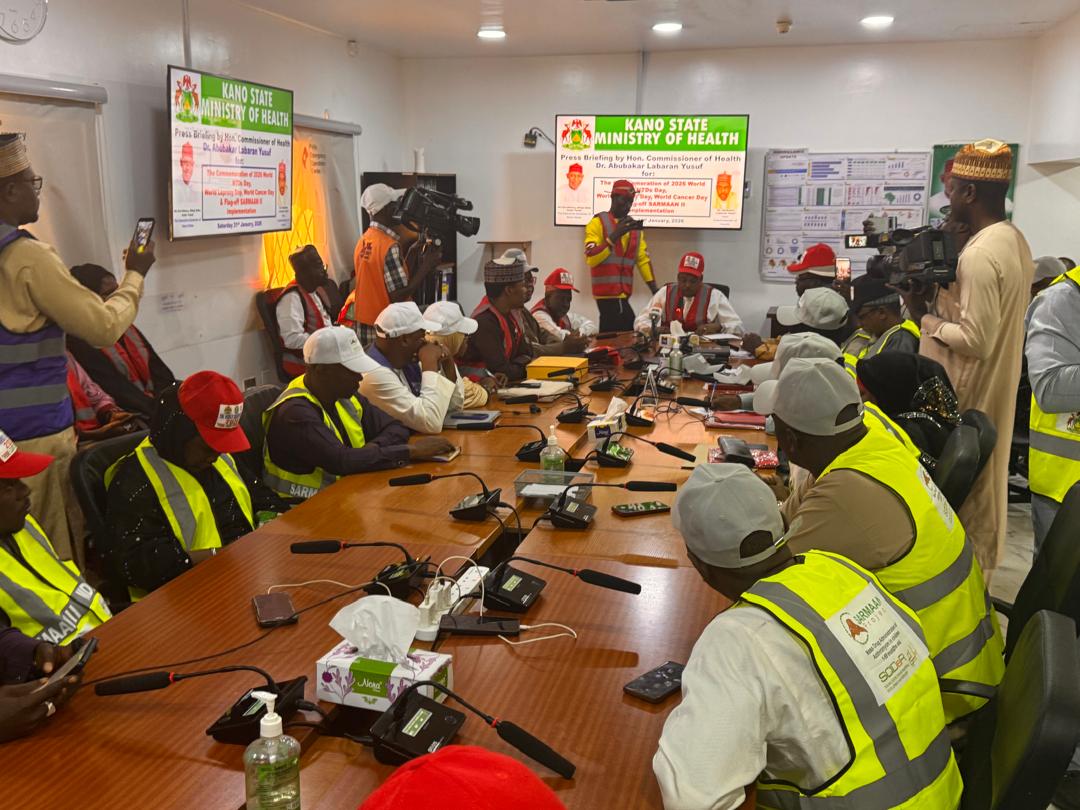
“Kano Govt Invested Over ₦5.4 Billion to Fight Malaria” Health Commissioner
By Ayeeshat J Ahmad
Kano State Government has committed over ₦5.4 billion to strengthen malaria prevention and treatment as part of efforts to reduce the burden of the disease across the state.
The Commissioner for Health, Dr Abubakar Labaran Yusuf, disclosed this during a press briefing to mark World Malaria Day, celebrated annually on April 25.
He said the investment, supported by partners including the Global Fund, has enabled the procurement and distribution of anti-malarial commodities to 839 health facilities across the state, ensuring free access to treatment for residents.
Dr Yusuf noted that the 2026 theme, “Driven to End Malaria: Now We Can. Now We Must,” reflects the urgent need to accelerate efforts toward eliminating malaria, which continues to pose a major public health challenge.
Citing the World Malaria Report 2025, the Commissioner said 282 million malaria cases were recorded globally, with Africa accounting for 88 percent of the burden, while Nigeria alone contributes 24.3 percent.
In Kano State, malaria remains the leading cause of hospital visits, accounting for about 60 percent of outpatient cases in 2025, with over 4.3 million hospital visits .
The Commissioner added that the government has scaled up Seasonal Malaria Chemoprevention, with over 3.5 million doses administered to children under five between July and October 2025, while targeting at least 3 million children in 2026.
He also highlighted the distribution of insecticide-treated nets and ongoing efforts to strengthen health systems through training of personnel and improved surveillance to control mosquito breeding.
Under the leadership of Governor Abba Kabir Yusuf, the state is also exploring innovative approaches, including plans to pilot Larval Source Management in high-burden areas, with over ₦100 million earmarked for the initiative.
Dr Yusuf said the interventions are already yielding positive results, as malaria prevalence among children under five has dropped from 26 percent in 2021 to 18 percent in 2025, lower than the national average.
“Government alone cannot win this war. Communities must maintain clean environments to eliminate mosquito breeding sites, while the private sector should support elimination efforts,” he said.
Pulse Times Nigeria reports that,the commissioner however,appreciated development partners such as WHO, UNICEF, and others for their continued support, as well as the media for playing a critical role in raising awareness.