


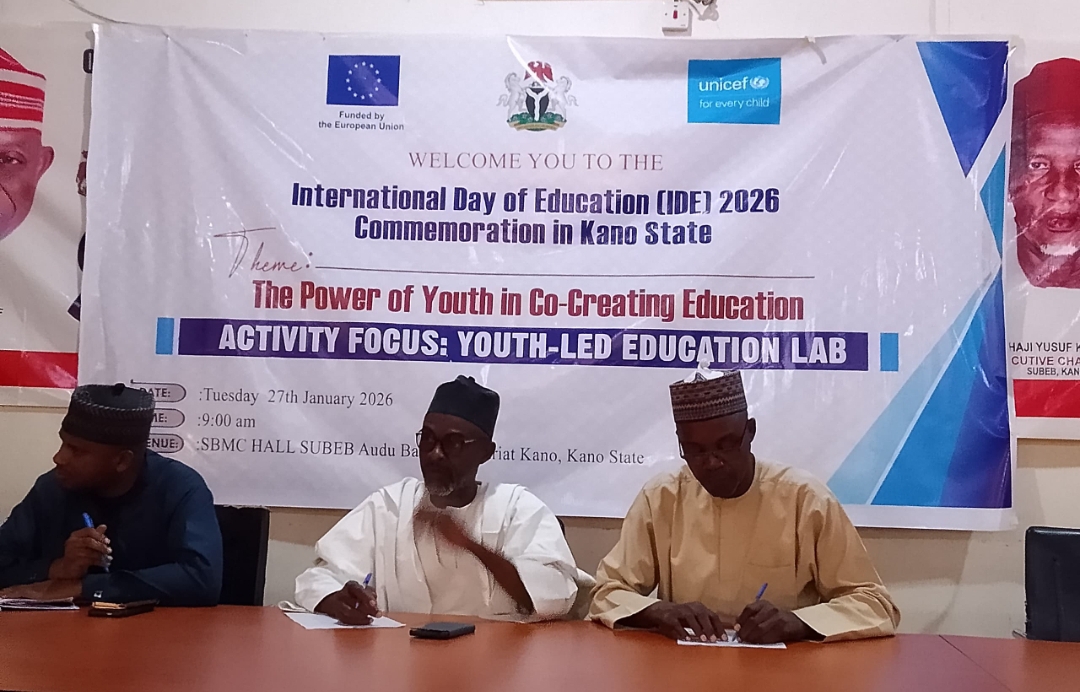
Celebrating IDE 2026: Kano Government, UNICEF Champion Youth-Led Education
Aishat J. Ahmad
The Kano State Government, in collaboration with the United Nations Children’s Fund (UNICEF), has reiterated its commitment to youth-led and inclusive education reforms as the state marked the 2026 International Day of Education .
Speaking during the commemoration, the Executive Chairman of the Kano State Universal Basic Education Board (SUBEB), Alhaji Yusuf Kabir, said the state has deliberately positioned young people as key partners in shaping education policies, curricula and school governance, in line with the 2026 theme, “The Power of Youth in Co-Creating Education.”
Kabir noted that Kano State has made measurable progress in reducing the number of out-of-school children through inclusive education policies, including the integration of Qur’anic schools into the formal education system and expanded access for children living with disabilities.
“Kano State is proud to place young people at the heart of our education agenda. They are not just beneficiaries, but active partners in building a system that responds to present and future needs,” he said.
On manpower development, the SUBEB chairman disclosed that over 8,000 public schools across the state are currently supported by about 50,000 teachers, adding that 4,315 former BESDA volunteers have recently been absorbed as permanent staff. He further revealed that the state is in the process of recruiting an additional 4,000 teachers.
He explained that to strengthen supervision and service delivery, the state government has introduced a teacher-vehicle loan scheme and provided 444 motorcycles and 300 computers for effective school monitoring.
Kabir also said more than 2,000 classrooms have been renovated while 250 new ones have been constructed across the state, adding that 1,600 security personnel have been deployed to ensure safety in schools.
On gender inclusion, he said the adoption of Gender-Responsive Budgeting in Education (GREB) has ensured that education spending addresses the specific needs of girls, including sanitation, mentorship and safe transportation. According to him, over 30,000 girls have been returned to school through the AGILE project.
He added that the state plans to expand digital literacy, increase scholarship opportunities and strengthen School-Based Management Committees (SBMCs) to promote community ownership and sustainability, while partnerships such as the National Home-Grown School Feeding Programme will continue to boost school attendance and learning outcomes.
Meanwhile,in his remark the Chief of UNICEF Field Office Kano, Mr. Rahama Rihood Mohammed Farah, described education as a fundamental human right and the foundation of peaceful and prosperous societies.
Delivering a keynote speech at the IDE 2026 commemoration held at the UNICEF Kano Field Office, Farah said education remains a powerful tool for breaking cycles of poverty and restoring dignity across Kano, Katsina and Jigawa states.
“Education is not just a service; it is a right, a beacon of hope, and the foundation of every strong society,” he said.
He stressed that despite progress recorded, many children—especially girls—are still denied access to quality education due to poverty, insecurity, harmful social norms and limited resources.
Farah called for collective action, noting that the future of education must be relevant, inclusive, safe and empowering, while equipping young people with life skills, digital knowledge and critical thinking.
He reaffirmed UNICEF’s commitment to supporting governments in strengthening education systems, improving learning environments and promoting adolescent development.
“When you educate a child, you uplift a family. When you educate a girl, you strengthen a community. And when you invest in education, you build peace and development for generations,” he added.
The IDE Event brought together government officials, development partners, educators, media practitioners and young people from the Kano and U reporters from UNICEF Field Office renewing their commitment to ensuring that every child in Kano state has access to quality education